

In the world of digital systems, software development, and automated computing environments, technical identifiers are used everywhere. These identifiers help developers, administrators, and systems organize information efficiently. While some names are easy to understand, others appear cryptic and difficult to interpret. One example of such an identifier is kutop-cs.536b.
At first glance, kutop-cs.536b appears to be a random collection of letters, numbers, and symbols. To someone unfamiliar with technical environments, it may not seem to have any obvious purpose. However, structured identifiers are rarely created without reason. They are often designed to communicate specific information within software, databases, servers, testing environments, or development frameworks.
Understanding how identifiers like kutop-cs.536b function can provide insight into modern software architecture and system organization. Although the exact meaning may vary depending on the environment where it appears, examining its structure reveals how technical naming conventions help maintain order in increasingly complex digital ecosystems.
The Importance of Structured Identifiers in Technology
Every modern computing system relies on identifiers to organize resources, modules, files, and configurations. Without structured naming systems, managing large-scale software projects would become extremely difficult. Developers need reliable ways to locate components quickly and distinguish one resource from another.
Identifiers often serve as references that connect different parts of a system. A development team may use them to track software versions, monitor testing environments, identify modules, or categorize internal tools. These references make communication more efficient and reduce confusion during development and maintenance.
As organizations build larger applications and infrastructures, naming conventions become increasingly important. A well-designed identifier allows systems and humans to understand relationships between components. In many cases, strings such as kutop-cs.536b represent a small but essential part of broader organizational strategies within technical environments.
Breaking Down the Structure of kutop-cs.536b
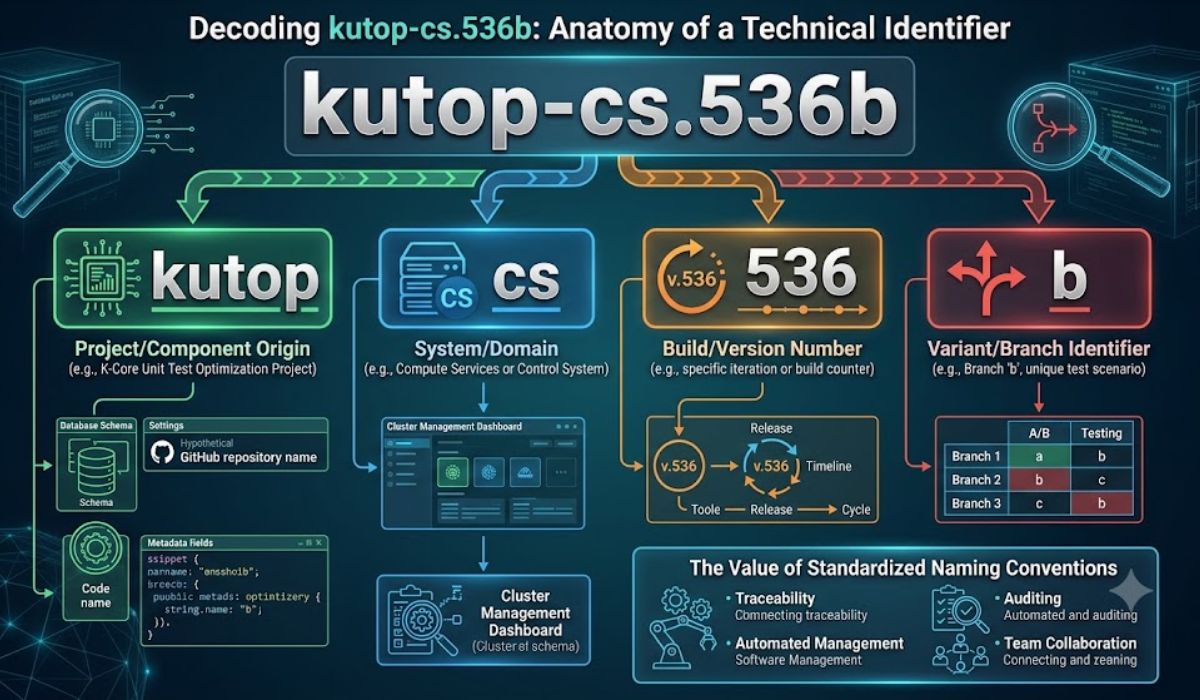
The identifier kutop-cs.536b appears to consist of several distinct sections. The first segment, “kutop,” may represent a project name, organizational code, platform label, or internal system reference. Development teams often use short prefixes to indicate ownership or project classification.
The second section, “cs,” could indicate a subsystem, module category, environment designation, or departmental abbreviation. Similar abbreviations are commonly used to separate software components and make large systems easier to navigate. This approach helps developers quickly recognize where a particular resource belongs.
The final segment, “536b,” resembles a version number, build identifier, revision code, or testing marker. Numeric values combined with letters are frequently used in software development because they provide a simple method for tracking changes and distinguishing releases. Together, these segments create a structured identifier that can communicate valuable information within a technical framework.
Possible Use as a Software Version Identifier
One of the most common uses of identifiers like kutop-cs.536b is software version tracking. Development teams release multiple versions of applications throughout their lifecycle. Each update may introduce new features, bug fixes, performance improvements, or security enhancements.
Version identifiers help teams understand which release is currently deployed. They also make troubleshooting easier because developers can quickly determine whether a reported issue exists in a specific build. A structured label ensures that everyone involved in the project references the same software version.
In this context, kutop-cs.536b could represent a particular release stage within a software project. The identifier might be attached to internal builds, beta versions, staging deployments, or production releases. Such naming conventions improve traceability and support long-term maintenance efforts.
Role in Development and Testing Environments
Testing environments require clear identification systems to avoid confusion between development stages. Software often moves through multiple environments before reaching users. These stages may include development, quality assurance, staging, and production.
Each environment contains unique configurations and testing requirements. To ensure smooth deployment processes, teams create identifiers that distinguish one environment from another. These references reduce the risk of accidental deployments and configuration errors.
The identifier kutop-cs.536b may function as a testing reference within such an environment. It could indicate a specific build undergoing evaluation, a configuration prepared for quality assurance, or a deployment candidate awaiting approval. Clear identification helps maintain consistency throughout the development cycle.
Internal Module and Component Classification
Modern applications are often built using modular architectures. Instead of creating one large system, developers divide applications into smaller components that perform specialized tasks. These modules work together while remaining independently manageable.
Each module requires a unique identifier to prevent ambiguity. Teams frequently create naming conventions that include project prefixes, subsystem indicators, and version markers. These conventions simplify maintenance and make documentation easier to understand.
Within a modular architecture, kutop-cs.536b could represent a specific component or service. The identifier may help developers locate source code, monitor performance, review documentation, or implement updates without affecting unrelated sections of the system.
Database and Configuration References
Databases store enormous amounts of information, making organization essential. Technical identifiers are often used to label records, configuration entries, schemas, and operational settings. Proper labeling improves efficiency and supports accurate data management.
Configuration systems also rely heavily on identifiers. Applications require numerous settings that determine behavior, permissions, integrations, and performance characteristics. Administrators use structured references to manage these settings consistently across environments.
In such scenarios, kutop-cs.536b might act as a configuration tag or database reference. The identifier could connect system settings to specific modules, deployments, or operational requirements. This level of organization helps ensure reliable application performance.
Benefits of Using Structured Naming Conventions
Structured naming conventions provide numerous advantages for organizations managing complex systems. One major benefit is improved clarity. Consistent naming allows team members to understand resources more quickly without requiring extensive explanations.
Another advantage is scalability. As projects grow, thousands of files, modules, and services may need identification. A standardized naming approach prevents disorder and supports efficient navigation throughout large infrastructures.
Structured identifiers also improve automation. Scripts, monitoring tools, and deployment pipelines often rely on naming patterns to perform tasks automatically. An identifier like kutop-cs.536b may fit within a broader framework designed to streamline operational workflows.
Security and Traceability Considerations
Security teams often use identifiers to track system activity and maintain accountability. Logs generated by applications frequently contain references that help investigators understand what occurred during specific events or incidents.
Traceability is especially important in environments where multiple teams collaborate. When an issue arises, identifiers make it easier to locate the responsible component, review changes, and determine the sequence of events leading to a problem.
If kutop-cs.536b appears within logs or monitoring systems, it may provide valuable context during troubleshooting efforts. Such identifiers contribute to operational transparency and support efficient incident response procedures.
Why Technical Identifiers Often Seem Mysterious
Many technical identifiers appear confusing because they are designed primarily for functionality rather than readability. Developers prioritize uniqueness, consistency, and automation compatibility over user-friendly naming.
Different organizations also maintain their own naming standards. An identifier that makes perfect sense within one company may seem completely cryptic to outsiders. Without access to internal documentation, determining an identifier’s exact purpose can be challenging.
This explains why names such as kutop-cs.536b often attract curiosity. Although they may appear random, they typically follow established conventions that carry meaning within a specific technical context.
Conclusion
The identifier kutop-cs.536b illustrates how modern digital systems depend on structured naming conventions to maintain organization and efficiency. While its exact purpose cannot be determined without additional context, its format strongly suggests a role within software development, configuration management, testing environments, or system administration.
Technical identifiers help developers track versions, classify modules, manage deployments, organize databases, and support automation processes. Their importance continues to grow as software ecosystems become larger and more complex. What appears to be a simple string of characters may actually represent a critical reference within a sophisticated technological framework.
As organizations continue to build advanced digital infrastructures, identifiers like kutop-cs.536b will remain essential tools for communication, traceability, and operational management. Understanding these naming conventions provides valuable insight into the structured systems that power modern technology.
 admin
admin